Exceptionally high temperatures, combined with the prolonged drought affecting many agricultural areas across Italy and Europe, are bringing renewed attention to an issue that has become increasingly central to the agri-food sector in recent years: mycotoxin risk management.
A hot summer does not automatically translate into higher contamination levels.
The relationship between weather patterns and mycotoxin development is far more complex and depends on the crop, the fungal species involved, the phenological stage, subsequent weather events, and harvesting and storage conditions.
Extreme weather events are, however, among the key factors that can alter the risk profile of raw materials. For this reason, food companies, feed manufacturers and laboratories should reassess their monitoring plans ahead of the new production season.
Climate change is also reshaping contamination profiles
Mycotoxins are metabolites mainly produced by fungi belonging to the genera Aspergillus, Fusarium and Penicillium. The development of these microorganisms depends on the interaction of several environmental factors, including:
- prolonged water stress in crops;
- high temperatures during flowering and ripening;
- damage caused by insects or mechanical injuries that facilitate fungal colonisation;
- alternation between dry periods and heavy rainfall;
- suboptimal drying and storage conditions.
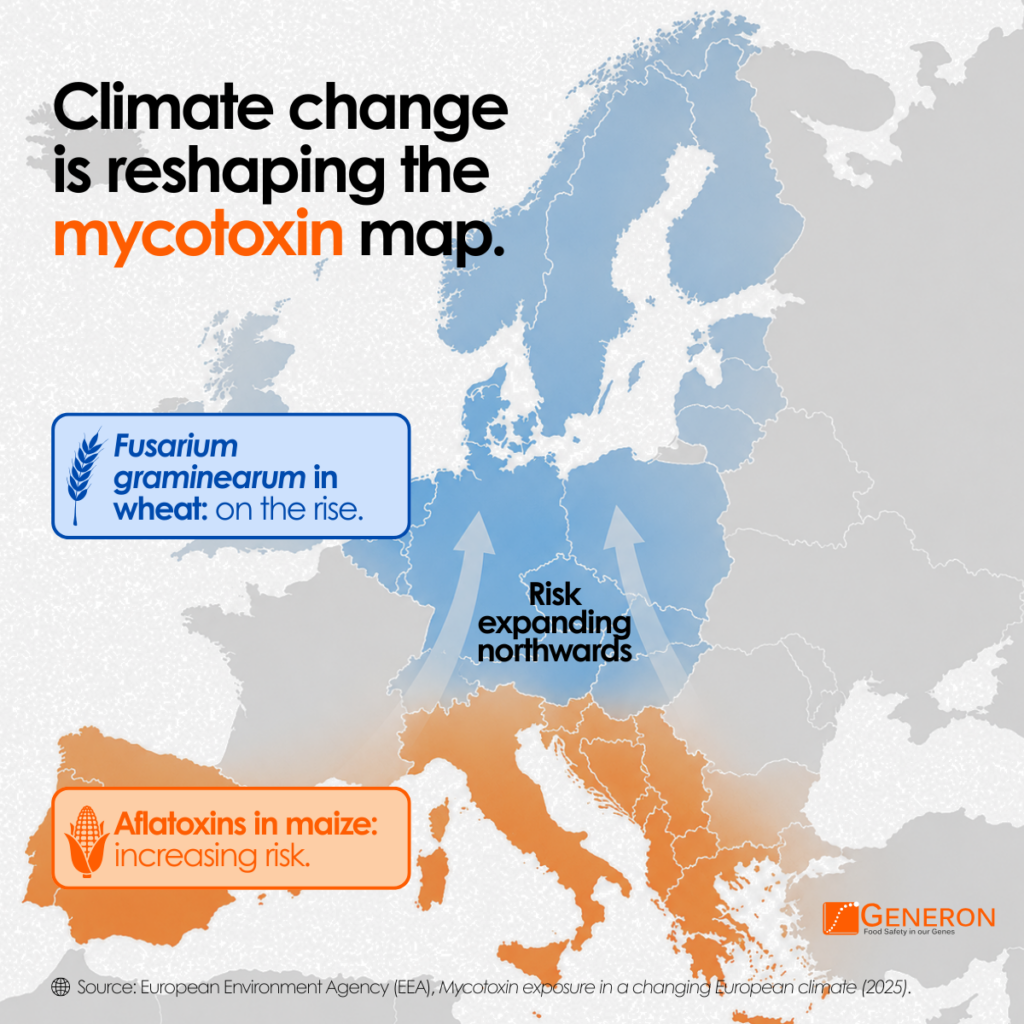
In recent years, scientific research has shown that climate change is affecting the geographical distribution of toxigenic fungal species and, consequently, the contamination patterns observed in major crops.
This means that risk can no longer be assessed solely on the basis of previous years’ experience, but requires a dynamic approach that is updated according to seasonal conditions.
Where should monitoring efforts be focused?
Each supply chain presents specific areas of concern.
In maize, particularly hot summers and periods of water stress can create conditions that favour the development of fungi producing aflatoxins and fumonisins, especially when followed by weather events that support fungal growth.
In wheat, the situation is different: the risk of contamination with deoxynivalenol (DON) and zearalenone is strongly influenced by weather conditions during flowering and the immediately subsequent stages.
Nuts, spices, cocoa, coffee and many raw materials intended for animal feed also require particular attention, especially when sourced from areas that have experienced unusual weather conditions.
Today, the focus should be less on identifying a single raw material “at risk” and more on assessing geographical origin, weather patterns during the growing season and supplier history as a whole.
Is it time to review the control plan?
One question many companies ask is whether, in the presence of a particularly hot summer, the monitoring plan should be adjusted. The answer is that there are several factors every quality manager should take into consideration:
- check whether sourcing areas have experienced exceptional weather conditions;
- reassess the risk level of the most sensitive raw materials;
- increase the frequency of controls upon receipt, if necessary;
- monitor storage parameters more closely during warehousing;
- update the HACCP plan based on the latest available evidence.
The objective is to allocate resources where the likelihood of contamination is genuinely higher.
Sampling remains the most critical step
When discussing mycotoxin analysis, the focus often tends to be on comparing the sensitivity, detection limits or performance of different analytical methods.
In fact, the reliability of the result depends first and foremost on the quality of sampling.
Mycotoxins are characterised by an extremely heterogeneous distribution within a batch. A non-representative sample can compromise the result, regardless of the technology used for the analysis.
For this reason, it is essential to adopt sampling procedures that comply with current regulations and are proportionate to the type and size of the batch.
Screening or confirmation? Each method has its own role
A modern control plan should include different methods, selected according to the specific objective.
Screening techniques allow a large number of samples to be analysed quickly, making them particularly effective in raw material acceptance procedures and routine risk management.
When the objective is to determine the concentration of a specific mycotoxin with high accuracy, or to confirm a screening result, quantitative methods and high-sensitivity chromatographic techniques are required.
Technology selection should be guided not only by analytical performance, but also by the role each method plays within the quality control process.
From regulatory compliance to preventive risk management
As climate variability increases, an approach based solely on compliance with legal limits is becoming increasingly less effective.
Today, the companies achieving the best results are those that bring together climate data, raw material knowledge, supplier monitoring and analytical controls within a single risk assessment system.
In this context, the laboratory is not only where sample compliance is verified. It also becomes a true decision-making tool, capable of supporting timely decisions across the entire supply chain.
As the climate evolves, the approach to mycotoxin control must also evolve, becoming a continuous process of prevention and risk management based on reliable data, representative sampling and analytical methods suited to different operational needs.
The four most common mistakes in mycotoxin control
1. Increasing testing without reassessing risk
The frequency of controls should be defined based on the actual risk associated with the raw material and the conditions of the growing season.
2. Neglecting sampling
Most of the uncertainty in mycotoxin determination comes from sampling. A non-representative sample can compromise even the highest-performing analytical method.
3. Using the same control plan over time
The monitoring plan should be reviewed periodically and adapted as risk evolves.
4. Treating screening and confirmation as competing methods
Screening and confirmation methods serve different purposes and, when properly integrated, enable more effective and efficient control.