
European dairy production is expanding in a challenging market environment. According to the European Commission, EU milk production is expected to grow by 1.8% in 2026, despite higher input costs and challenging weather conditions that continue to put pressure on dairy producers.
In this context, operational efficiency remains a key consideration, including how quality control and food safety activities are organized. At milk intake, during processing and in the laboratory, turnaround time, sample volumes, the range of contaminants to be monitored and the type of result required all influence the choice of testing methods.
Generon has expanded its dairy portfolio with complementary technologies for rapid screening, laboratory analysis and process monitoring.
Antibiotic residues in milk: selecting the right screening approach
Antibiotic residue testing is a critical step in raw milk management. Whether testing takes place directly on the farm, during milk collection and transportation, or at the food-processing facility, results must support timely decisions about milk acceptance and further processing.
For these applications, rapid turnaround times, broad analyte coverage, the appropriate detection sensitivity and the availability of suitable testing equipment are important factors when selecting a method.
Generon’s immunoFlow Lateral Flow Test Kits offer different testing formats designed to meet these operational requirements.
The immunoFlow Strip Tests work directly with cold milk, delivering results in approximately 7 minutes without requiring a heated incubator or heat block. This makes them particularly suitable for on-site testing, including locations where laboratory equipment or access to electricity may be limited.
The portfolio includes multi-residue assays covering different antibiotic classes. For example, the immunoFlow BTSQ Strip Test detects 15 beta-lactams, 3 tetracyclines, 19 sulfonamides and 3 fluoroquinolones, with detection sensitivities stated to be below the corresponding EU Maximum Residue Limits (MRLs).
For facilities handling multiple samples and preferring a more streamlined procedure, immunoFlow Cassette Tests eliminate the preliminary mixing step; they require incubation but reduce manual handling during the testing workflow.
The first-in-class portable immunoFlow reader, equipped with an integrated incubator, timer and reading software, supports both strip and cassette formats and provides unmatched flexibility when testing requirements or operating conditions change.
Microbiological Screening and ELISA Analysis
For farms and laboratories managing large numbers of milk samples, broader antimicrobial screening may be required.
The SporoCheck AT Test Kit offers a microbiological approach based on growth inhibition, detecting more than 60 antimicrobial substances across eight groups. Multiple samples can be processed in a single run, with an incubation time of approximately 135–165 minutes at 65°C.
For laboratories requiring analysis of specific antibiotic residues, Gen.Isa ELISA Test Kits provide targeted microplate assays. These can be particularly relevant when multiple samples need to be analyzed for selected compounds under controlled laboratory conditions.
The combination of rapid lateral flow, microbiological screening and targeted ELISA methods allows dairy operators and laboratories to organize antibiotic residue testing according to their analytical priorities, testing environment and sample throughput.
Aflatoxin M1: testing requirements across the dairy supply chain
Monitoring begins with animal feed and continues through milk collection and dairy processing.
Dairy animals can metabolize aflatoxin B1 present in contaminated feed into aflatoxin M1, which can then pass into milk. Feed testing therefore represents an important upstream control activity, alongside direct analysis of milk and dairy products.
Within the European Union, Regulation (EU) 2023/915 establishes a maximum AFM1 level of 0.050 µg/kg (50 ppt) for raw milk, heat-treated milk and milk intended for the manufacture of milk-based products.
Testing requirements may differ between a dairy facility screening incoming milk batches and a laboratory performing quantitative analysis on milk powder, fermented products or other dairy matrices.
For rapid screening, immunoFlow Aflatoxin M1 Test Kits are available in qualitative and quantitative formats, including strips and cassettes. The range offers different sensitivity levels and reading options, allowing users to select a configuration appropriate to the sample and analytical objective.
Quantitative immunoFlow M1 assays offer a stated detection limit of 15 ppt, with a measurement range of 15–150 ppt, using the required reading equipment.
For quantitative laboratory analysis, the Gen.Isa Aflatoxin M1 HS ELISA Kit provides a dedicated assay with a stated sensitivity of 15 ppt. Its applicability to a range of dairy matrices, including raw and processed milk, milk powder, fermented products and cheese, supports different laboratory testing requirements.
Laboratories can use the kit with any commercially available microplate reader.
Sample Preparation for Instrumental Analysis
For instrumental analysis, sample preparation introduces an additional requirement.
Gen.iac Immunoaffinity Columns selectively isolate and concentrate aflatoxins while reducing matrix interference before chromatographic analysis, including HPLC and LC-MS/MS applications.
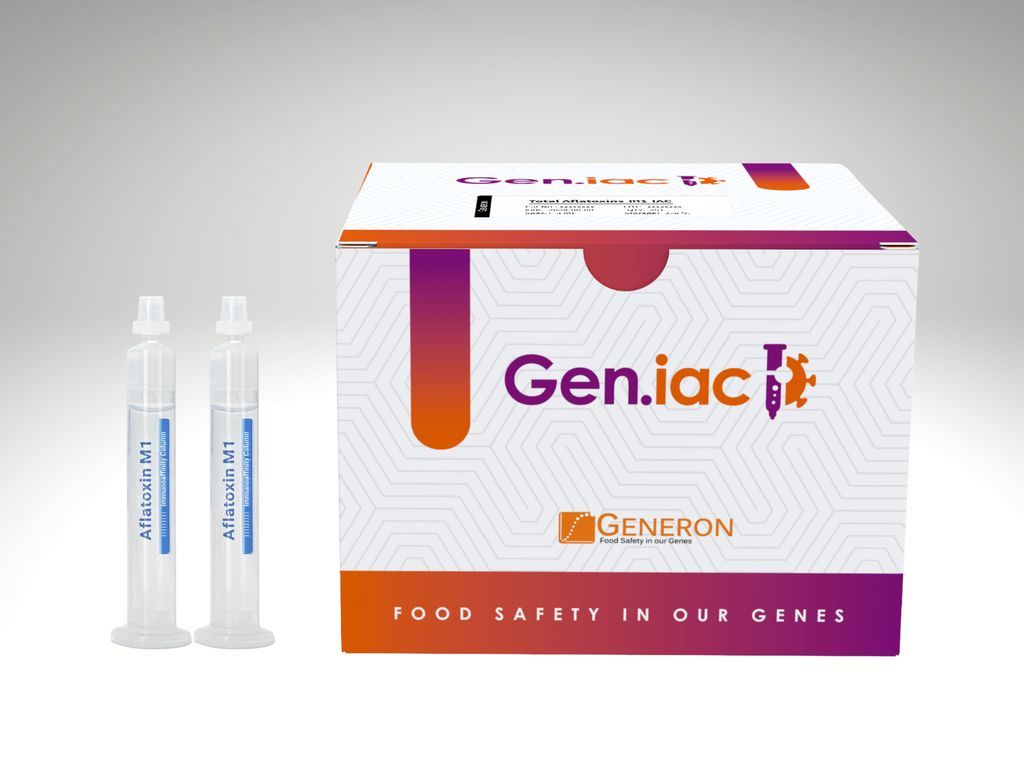
Dedicated columns are available for aflatoxin M1, combined M1/M2 analysis and multi-mycotoxin applications.
These technologies support different stages of AFM1 analysis, allowing laboratories to select the appropriate approach according to the required sensitivity, sample matrix and analytical workflow.
Staphylococcal enterotoxins: detection and typing in dairy products
When laboratories suspect contamination in cheese or other dairy products, they may need to detect staphylococcal enterotoxins or to identify specific enterotoxin types.
For laboratories handling different dairy matrices, the distinction between total enterotoxin detection and typing determines the analytical approach.
Generon’s Gen.Isa ELISA range offers two dedicated solutions: the Staphylococcus aureus Enterotoxin ELISA Kit for total enterotoxin detection and the Enterotoxin Typing ELISA Kit for the identification of types A, B, C, D and E. Both assays are suitable for a range of matrices, including raw and processed milk, fermented products, milk powder and whey powder.
Pasteurization monitoring: residual ALP activity and quantitative results
For dairy processing facilities, pasteurization verification is another important part of routine quality control.
Adequate pasteurization inactivates alkaline phosphatase (ALP), an enzyme naturally present in milk. Measuring its residual activity provides an indication of treatment effectiveness and can help identify the possible presence of insufficiently pasteurized milk.
The SafeGen ALP Test Swab is a ready-to-use solution for the measurement of residual alkaline phosphatase activity in pasteurized liquid milk and dairy products.
The test uses a chemiluminescent reaction, with the resulting signal measured by the SafeGen Touch luminometer to obtain a quantitative result correlated with residual ALP activity.
The system has a stated sensitivity of 20 mU/L, corresponding to approximately 0.002% raw milk. It supports rapid pasteurization checks.
The analytical result is only one part of the monitoring process: in facilities operating several production lines or managing testing activities across different sites, access to historical results and centralized information can also be relevant. SafeGen Touch records test results and synchronizes them through its cloud-connected platform. Users can access measurement history across devices and sites.
This combination of quantitative analysis and digital result management supports traceability, routine verification and the monitoring of pasteurization controls over time.
With dedicated swabs, the SafeGen Touch luminometer also supports ATP-based hygiene monitoring of surfaces and water samples.
Additional laboratory applications: nutritional analysis
Beyond contaminant testing and process monitoring, dairy laboratories may also need to analyze nutritional components, particularly when working with milk-based products, fortified formulations, infant formula or other matrices requiring instrumental analysis.
The Gen.iac Immunoaffinity Columns range includes dedicated solutions for sample preparation in the analysis of vitamin B9 (folic acid), vitamin B12 and vitamin B7 (biotin).
These columns support selective clean-up and concentration before instrumental analysis, extending the applications of Generon’s sample preparation portfolio to nutritional testing.
The Gen.iac portfolio also includes columns for heparin analysis.
Analytical solutions supported by technical expertise
Choosing the appropriate testing method involves more than selecting an assay with suitable analytical performance. Sample matrices, laboratory equipment, daily testing volumes and existing procedures can all influence the implementation of a solution.
Generon combines its portfolio of analytical technologies with dedicated technical and application support, helping customers identify and implement solutions suited to their specific requirements.
Drawing on its experience in food analysis and laboratory applications, Generon’s technical team provides assistance with data evaluation and result interpretation, protocol optimization and the development of customized kits and products for specific needs.
Support also includes joint demonstrations with customers and assistance with local accreditation activities. For laboratories working with molecular testing methods, the team can provide guidance on the use of software from other thermocycler manufacturers.
This approach allows Generon to work alongside dairy producers, quality control teams and analytical laboratories, addressing practical testing requirements and supporting the integration of methods into established workflows.
Explore Generon’s dairy testing portfolio or contact our technical team to discuss the most suitable analytical solutions for your specific applications.