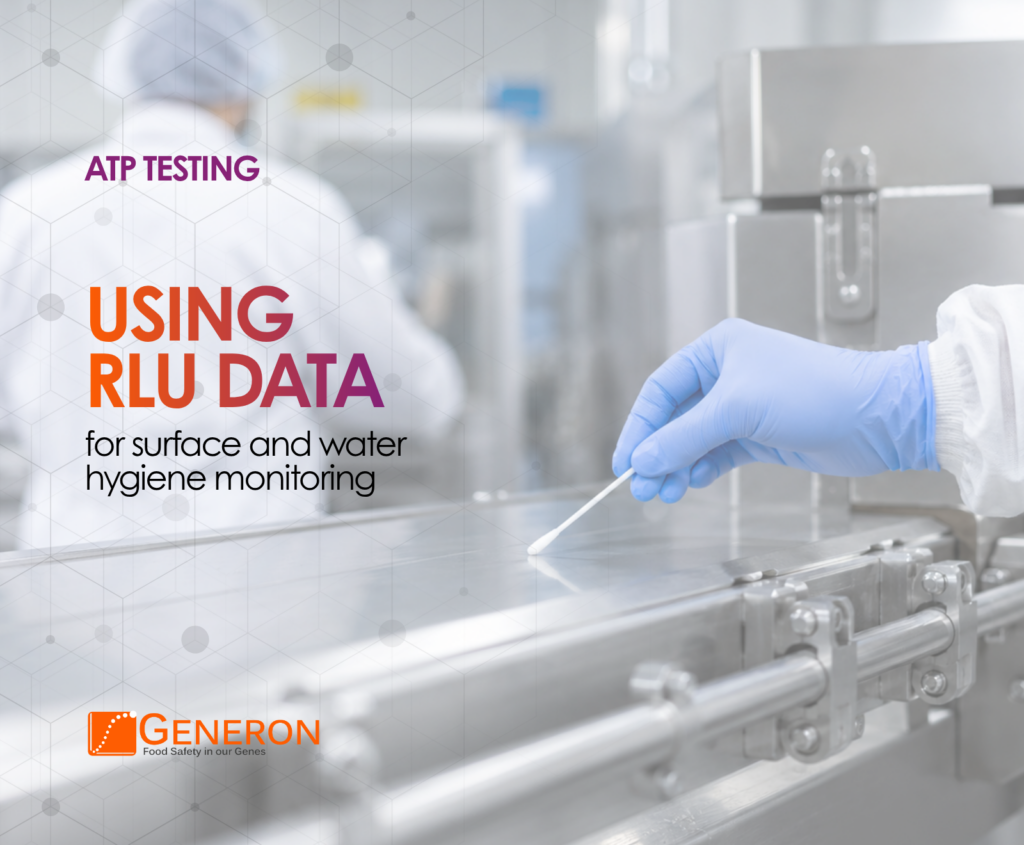
A surface may look clean after cleaning procedures, but for quality, production and laboratory teams, visual inspection is often not enough. In hygiene monitoring programs, ATP testing provides a rapid, quantitative indication of the presence of organic residues on surfaces, equipment, critical control points and, where applicable to the method, water samples.
The result is reported in RLU, Relative Light Units, and can help document controls, compare data over time and identify any changes in the hygiene conditions of an area or process.
ATP testing, however, must be interpreted correctly: it does not identify specific pathogens, it does not replace microbiological analyses and, on its own, it does not certify the effectiveness of sanitation. Technical literature confirms that ATP tests are used to assess cleanliness and the presence of organic residues, but they require a clear understanding of their limitations and of the differences between systems.
When a surface looks clean, data can provide further insight
In food companies, testing laboratories, hospitals, food, cosmetic and pharmaceutical production environments, as well as in catering and large-scale food retail, surface cleanliness is an essential part of control programs. Workbenches, equipment, conveyor belts, utensils, production lines and transit areas can all be exposed to organic residues that are not always visible.
For this reason, in hygiene monitoring programs, it is important to complement visual checks with tools that can provide measurable data. A numerical value makes it possible to record the result of the control, compare it against internally defined thresholds and monitor trends over time.
The goal is not to turn every check into a complex analysis, but to make cleanliness verification more objective at the points identified as critical in the company’s control plan.
What is ATP Testing?
ATP testing is a rapid method used to detect the presence of ATP, adenosine triphosphate, a molecule found in living cells and in many residues of biological origin.
In the context of hygiene monitoring, the presence of ATP on a surface or in a sample may indicate that organic material remains after cleaning procedures. This information can be useful to assess whether a point requires further checks, additional cleaning or investigation according to internal procedures.
ATP testing is therefore a supporting tool for hygiene verification: it provides a rapid, quantitative indication that is particularly useful when quality teams need to make operational decisions quickly.
ATP: why it is used as an indicator
ATP is associated with biological matter. It can originate from food residues, microbial cells, yeasts, moulds or other organic sources. For this reason, its detection is used as an indicator of residues that may remain after cleaning.
This is an important point: an ATP test does not identify the exact origin of the residue. A high value does not automatically indicate the presence of bacteria, pathogens, allergens or toxins. Rather, it shows that, at the sampled point, the amount of ATP detected was higher than the reference value defined for that specific control.
In a well-structured program, this information may be sufficient to trigger a corrective action, repeat cleaning or further investigate the result using other methods.
How an ATP test generally works
In simple terms, an ATP test involves sampling a surface with a swab, or collecting a sample that is compatible with the method being used. The sample is then analysed through a bioluminescence reaction.
The principle is based on the light emitted by the reaction between ATP and specific reagents, which is read by an instrument called a luminometer. The amount of light detected is converted into a numerical value reported in RLU, Relative Light Units.
The higher the RLU value, the stronger the signal detected by the instrument. However, interpretation of the data depends on the system used, the type of sample, the sampling point and the operational thresholds defined by the company.
To obtain comparable results, the sampling technique should be as consistent as possible. The sampled area, swab pressure, movement across the surface, activation time and reading time can all affect data quality. For this reason, in hygiene monitoring programs, ATP testing should be integrated into a standardised and repeatable procedure.
What are RLU values and how should they be interpreted?
RLU, Relative Light Units, are the unit of measurement used by the luminometer to report the signal generated by the ATP test.
In day-to-day operations, RLU values make it possible to turn a hygiene check into recordable data. This can help quality teams answer very practical questions:
- Is the checked point within the defined threshold?
- Is the result consistent with previous findings?
- Are there recurring variations on a line, a piece of equipment or a shift?
- Does cleaning need to be repeated?
- Should the procedure, frequency or operator training be reviewed?
The RLU value should always be interpreted within a defined program. When used as an isolated number, it may have limited value. When monitored over time, across consistent sampling points and with standardised procedures, it can become an operational indicator for assessing cleaning effectiveness.
Why RLU values are not universal
One of the most important aspects of ATP testing is threshold interpretation. RLU values are not universal values that can be automatically compared across different instruments, manufacturers, swabs or methods.
Each system may have its own sensitivity, reagents, reading geometry and interpretation criteria. For this reason, a threshold defined for one system should not be transferred to another system without verification.
Even within the same company, different points may require different thresholds. A smooth, easy-to-clean surface may behave differently from an area that is more complex, worn, porous or difficult to reach. Technical literature specifically highlights the importance of understanding practical applications, limitations, performance differences and criteria for defining pass/fail thresholds.
Operational thresholds, sampling points and trends
To make ATP monitoring useful, it is important to define a consistent plan. In general, this means establishing:
- which points should be checked;
- when the test should be performed;
- which sampling technique should be used;
- which thresholds should be applied;
- how the data should be recorded;
- which actions should be taken if the threshold is exceeded.
Sampling consistency is essential. Frequently changing the sampling point, the timing of the check or the sampling method makes it more difficult to compare results.
When data is collected regularly, however, ATP testing can help identify trends. A recurring increase in RLU values at a specific point may suggest the need to review the cleaning procedure, staff training, the condition of the surface or the frequency of checks.
Sampling standardisation is particularly important when results are used to compare different points or to analyse trends over time. Always sampling the same area, using a consistent technique and following defined timing helps reduce operational variability and makes RLU data easier to interpret.
Where ATP monitoring can be useful
ATP testing can be integrated at different stages of a hygiene monitoring program, especially when a rapid and documentable result is needed.
Surfaces, equipment and production lines
One of the most common applications concerns production surfaces and equipment. The test can be used on workbenches, utensils, conveyor belts, contact areas, accessible parts of production lines or other points identified in the control plan.
In these cases, the ATP value can help verify whether, after cleaning, organic residues are still present above the defined threshold.
For food, cosmetic and pharmaceutical companies, as well as testing laboratories, this can be particularly useful at points where production continuity requires fast, recordable decisions.
Critical points after cleaning procedures
ATP testing can support the verification of critical points after cleaning, before moving on to the next steps required by the company procedure.
The data can help identify areas that require repeat cleaning or more in-depth control. This approach is particularly useful when critical points have been defined based on risk, historical results, equipment complexity or relevance within the production process.
Water samples and rinsing systems
In some contexts, ATP testing can also be applied to water samples, such as rinse water or samples connected to specific cleaning systems, provided that the method and devices used are suitable for this application.
ATP testing, visual inspection and microbiological analyses: different roles within the same monitoring program
A hygiene monitoring program may include different tools, each with a specific function.
Visual inspection is simple, immediate and useful for identifying visible residues, gross contamination or macroscopic issues. However, it may not detect organic residues that are not visible.
ATP testing adds rapid quantitative data. It helps verify the presence of organic residues and record results that can be compared over time. It is particularly useful when a fast operational response is needed.
Microbiological analyses have a different role: they make it possible to detect, quantify or confirm microorganisms using specific methods. They require different timing and procedures, but they are essential when the goal is to assess the presence or level of specific microbiological indicators or target microorganisms.
These approaches can work together within the same program. ATP testing does not replace microbiological testing and does not identify specific pathogens. However, it can help make cleanliness checks faster, more measurable and easier to document.
Operational benefits for quality, production and laboratory teams
For quality managers, production managers and internal or external laboratories, the value of ATP testing is primarily operational.
An ATP system can support:
- rapid checks after cleaning;
- collection of numerical data;
- comparison of results over time;
- documentation of the points checked;
- identification of trends;
- support for corrective actions;
- clearer communication between quality, production and cleaning teams.
When data is collected and stored in a structured way, the value of the test goes beyond the individual check. Historical readings can help identify recurring variations, compare different areas or lines and document the corrective actions taken.
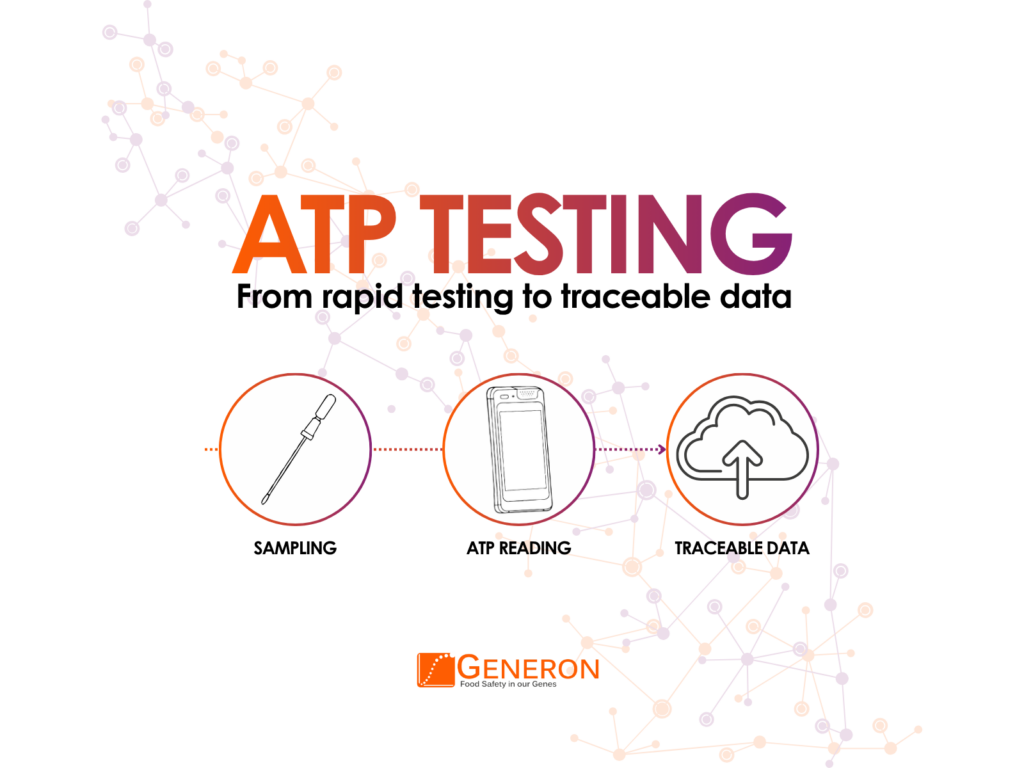
RLU data can become part of the history of the sampling point. Over time, this makes it possible to move from occasional checks to a more structured interpretation of hygiene conditions.
For example, if the same area shows variable results or values that frequently exceed the threshold, the team can investigate the possible causes: point accessibility, surface wear, inadequate procedures, cleaning times, detergent, operator training or changes in the production process.
Limitations of ATP testing to consider
To use ATP testing correctly, its limitations must also be clearly stated.
An ATP test:
- does not identify specific bacteria;
- does not detect specific pathogens;
- does not identify allergens, species or toxins;
- does not guarantee the absence of contamination;
- does not, on its own, certify the effectiveness of sanitation procedures;
- does not replace microbiological analyses;
- does not provide an automatic correlation with microbial counts;
- does not allow universal comparison of RLU values obtained with different systems.
These limitations help place this method in its proper role within a monitoring program.
ATP testing is particularly useful when the goal is to quickly verify the presence of organic residues and support operational cleaning decisions. When the objective is to identify a microorganism, confirm a pathogen or perform microbiological testing, specific analytical methods are required.
SafeGen ATP: tools for faster, measurable and traceable hygiene monitoring
In the context of hygiene monitoring, Generon expands its offering with the SafeGen ATP line, designed for food companies, laboratories and quality teams that want to integrate or strengthen ATP controls within their hygiene monitoring programs.
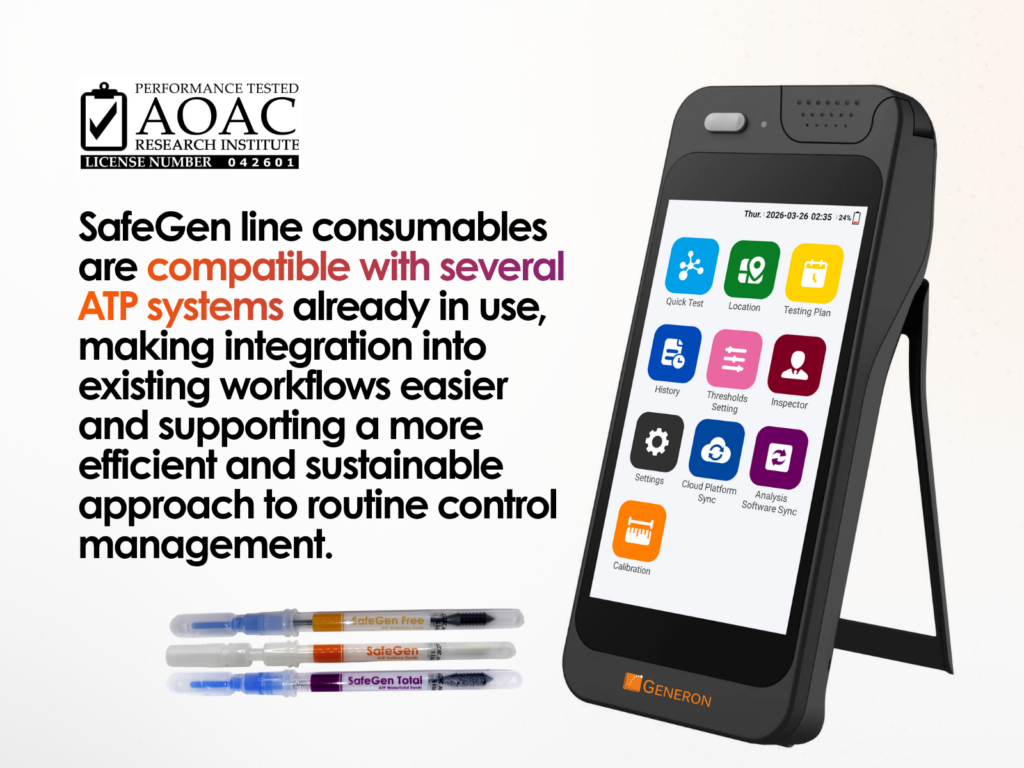
The line includes the SafeGen Touch ATP_GEN_3500 luminometer and dedicated sampling devices, including the SafeGen ATP Surface Swab, designed as a ready-to-use all-in-one system with a pre-moistened swab and integrated reagent.
The SafeGen ATP line is also AOAC-RI Performance Tested Methods℠ certified, an internationally recognised program for the validation of proprietary analytical methods, kits and systems. This provides an additional element of reliability for companies and laboratories that need to integrate ATP controls into documentable procedures aligned with their own quality standards.
Depending on the compatibilities defined in the technical specifications, the line’s consumables can be integrated with different ATP systems already in use, making it easier to fit them into existing workflows and supporting more sustainable management of routine controls.
The SafeGen Touch ATP_GEN_3500 system integrates data management and synchronisation features, with access to a dedicated cloud platform included in the system. This can help quality teams consult historical readings, link results to sampling points, monitor control trends over time and make hygiene monitoring program documentation more structured. These features can be particularly useful for companies with multiple lines, production areas or sites to monitor.
For applications on water samples, the line also includes dedicated solutions such as SafeGen ATP WaterTotal Swab and SafeGen ATP WaterFree Swab, to be evaluated according to the type of sample, the protocol adopted and the objectives of the control program.
Frequently asked questions about ATP testing
Is ATP testing used to detect bacteria?
ATP testing detects the presence of ATP, which may come from organic residues, microbial cells or other biological sources. It does not identify specific bacteria and, on its own, cannot determine the presence of a pathogen.
Does a high RLU value indicate microbiological contamination?
A high RLU value indicates an elevated ATP signal compared with the defined threshold. It may suggest the presence of organic residues, but it does not automatically determine the quantity or type of microorganisms present.
Does ATP testing replace microbiological analyses?
No. ATP testing plays a supporting role in the rapid verification of hygiene and cleanliness. Microbiological analyses remain necessary when the goal is to detect, confirm or quantify specific microorganisms.
When is ATP testing useful?
It can be useful after cleaning procedures, on surfaces, equipment, production lines or critical points defined in the monitoring plan. In some cases, with suitable devices, it may also be considered for water or rinse samples.
Are RLU values comparable across different systems?
No. RLU values should not be considered universal. Their interpretation depends on the system used, the type of sample, the control point and the operational thresholds defined.
Conclusions
ATP testing can help food companies, laboratories and quality teams make hygiene verification more objective and comparable over time, especially when it is integrated into a structured program with defined sampling points, consistent procedures and well-founded operational thresholds.
When used correctly, ATP data can support day-to-day decisions, highlight trends and contribute to more informed management of cleaning at critical points in the process.
With the SafeGen ATP line, Generon expands its offering with instruments and consumables designed to integrate or strengthen ATP controls within existing hygiene monitoring programs. The line supports more accessible routine controls, more organised results management and greater data traceability, also thanks to the cloud features included in the system.
To learn more about the SafeGen ATP line and evaluate the most suitable solution for surfaces, water samples and control objectives, contact the Generon team.